What an OT network is, why it is the weakest link in the organization, and what to do about it
On the night of October 11, 2026, hundreds of supermarkets across France woke up to steaming freezers. The affected chains included Intermarché, Netto, Coopérative U, Carrefour, Monoprix and E.Leclerc. Attackers had managed to trigger a forced defrost cycle remotely on the stores’ refrigeration controllers. Temperatures in the units reached 50 degrees Celsius and stayed there for hours. Goods worth millions of euros were thrown out, up to about 220,000 euros at a single store, and fires were reported at several locations. The investigation is still under way, but it is already known that the compromised controllers were running outdated software with known vulnerabilities, that some were end-of-life equipment no longer receiving updates, and that thousands of similar devices are exposed directly to the internet.
Note what did not happen. No ERP system was breached, no file server was encrypted, and no customer database was stolen. A controller was compromised: a small control unit that, in most organizations, nobody remembers is connected to the network.
This is not an isolated event. In recent weeks we have ourselves encountered at least six cases of attacks on controllers at organizations in Israel. In one, an industrial refrigerator storing medication, where a single temperature excursion means destroying the inventory. In another, a chlorine dosing controller at a swimming pool, where changing a single value turns a leisure facility into a health hazard. In a third, a fire detection controller, where whoever controls it can silence an alarm, or trigger it deliberately and shut down an entire building. In some of these cases, the controllers sat on the same network as the production servers, workstations and email.
What is an OT network?
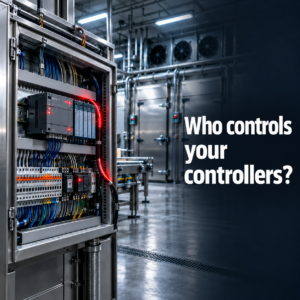
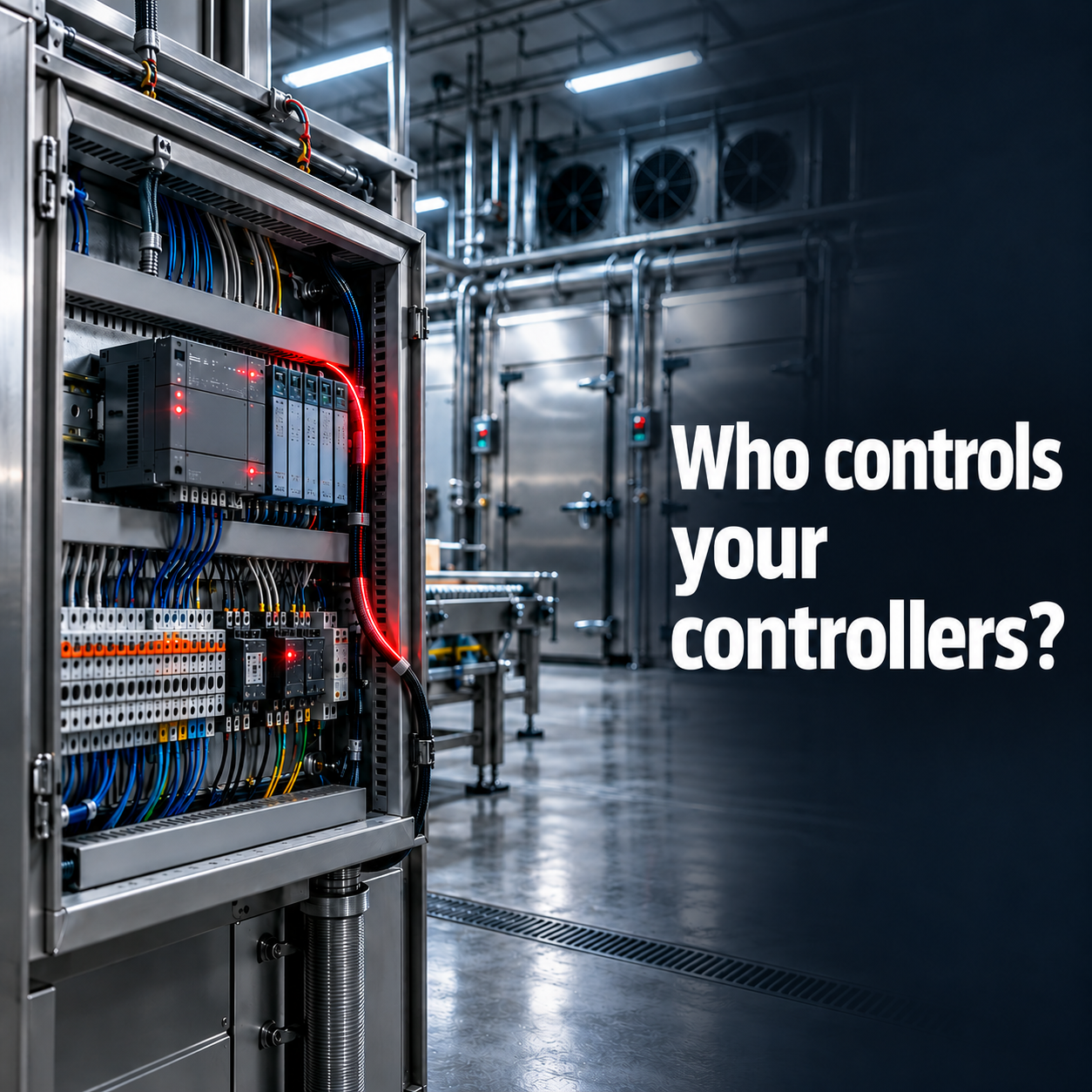
IT (information technology) is the world of computers, servers, software and data. OT (operational technology) is any equipment run by a computer that directly affects the physical world: PLC controllers for production machinery and the SCADA systems that manage them, refrigeration and HVAC controllers, access control and time clocks, gate and parking controllers, fire detection and suppression systems, elevators, cameras, UPS units and smart building systems.
Most organizations are not familiar with the term. Every organization has an OT network.
Why is it so hard to defend?
1. Protocols born without security. Controllers communicate over protocols such as Modbus, DNP3, BACnet and Profinet, most of which were designed in the 1980s and 1990s for physically closed networks. As a result, they have no authentication (anyone who can reach the port can send a write command) and no encryption.
2. Lifespans measured in decades. A computer is replaced every four to five years; a controller stays in service for 15 to 25. Firmware updates are rare and sometimes risky in themselves, since a failed update can stop a production line. At some point the manufacturer simply stops issuing updates, and the controller keeps running for years with its vulnerabilities intact.
3. Nowhere to install an agent. You cannot run EDR or antivirus on a controller. Protection has to be built around it, at the network level.
4. Vendor remote access. The refrigeration, HVAC or elevator technician is given a VPN or remote control tool “for support purposes”, often with a default password. Sometimes the controller’s management interface is exposed directly to the internet, for convenience.
5. No owner. The controller belongs to maintenance, production or the security officer, not to IT. No one manages its passwords, no one documents its version, and no one is consulted when it is connected to the network.
6. It is integrated into the IT network. In most mid-sized businesses there is no separation. When an attacker reaches the receptionist’s computer through a phishing email, they are on the same network as the chlorine controller.
If this sounds theoretical, consider the first documented case: the Stuxnet worm, which disabled centrifuges at the Natanz enrichment facility through Siemens PLC controllers, without the operators seeing anything unusual on their screens. The principle has remained the same ever since: whoever controls the controller controls the physical process.
The solution: segmentation, plus five more steps
1. Mapping. You cannot protect what you do not know exists. Build a complete inventory of every controller in the organization: what it operates, its firmware version, who the vendor is, who is responsible for it, and how it is connected.
2. Segmentation. This is the core. Everything that is not a computer moves to a separate network, either a VLAN (a virtual network separated on the same hardware) or a physical network. Between it and the office (IT) network sits a firewall with explicit rules: who talks to whom, on which port, in which direction. The Purdue model divides the network into levels, and the IEC 62443 standard defines “zones and conduits”: isolated zones and controlled crossing points between them. A control system that has to communicate with both sides (SCADA/HMI, the screen from which equipment is operated) sits in a DMZ, an isolated intermediate zone. Segmentation also applies within the OT network itself: the refrigeration controller has no reason to talk to access control.
3. Controlled remote access. No permanent VPN for vendors. Access goes through a jump host (a secure gateway that every vendor must pass through) with two-factor authentication, opened on request, for a limited time, and recorded. And never a controller exposed directly to the internet, which is exactly what failed the supermarkets in France.
4. Basic hygiene. Replace default passwords, disable unused services (legacy management interfaces such as Telnet and FTP, which transmit passwords in clear text), and apply firmware updates in a maintenance window coordinated with the vendor. A controller the manufacturer no longer supports should have a replacement planned.
5. Passive monitoring. OT traffic is predictable and cyclical, so deviations stand out. Monitoring network traffic, without installing anything on the controllers, detects a new address, a write command that was not seen before, or a device no one connected.
6. A plan for the day after. Back up the logic and configuration of every controller, and keep a written manual procedure: how to operate the refrigerator, the gate and the elevator when the controller fails.
The bottom line
Most of this work is not a mysterious discipline called “OT security”. It is classic networking and security work: mapping, segmentation, firewalls, access control and monitoring. These are exactly the areas where an organization that manages its IT professionally should already be strong. The only difference is that someone has to look at the controller in the machine room, in the cold storage room and in the communications cabinet by the gate.
The attackers have already looked there. The only question is who gets there first.
Not sure whether you have controllers exposed to the internet, or what is connected to your network at all? An OT assessment and controller mapping from T.O.M gives you, within a few days, a complete picture: which controllers exist, who can reach them, what is exposed externally, and a structured segmentation plan. It is part of the infrastructure and risk assessment service we provide to our clients, because peace of mind does not stop at the server room door.
To schedule an OT assessment for your organization, click here.
This article is based on reports about the refrigeration incident in France (11–13 October 2026) by AFP, Reuters, BFM TV, CBS News, and The Hacker News; statements from the supermarket chains Intermarché, Coopérative U, Carrefour, Monoprix, and E.Leclerc; a statement from Danfoss; and alert No. CERTFR-2026-ALE-012 issued by CERT-FR (France’s cybersecurity authority).