🟢 Understanding, mapping and planning: for every organization
🟡 Changes to customer identification, documents and encryption: for the IT team, with legal advice
As of November 2026 · Relevant for: executives · IT and information security managers · organizations that identify customers or employees remotely
Not relevant for: readers looking for technical implementation instructions. This article summarizes a draft that is open for public comment, and it is not legal advice.
| Risk classification:
🟢 Green – safe: reading the strategy, mapping your identification processes, mapping where ID photos are stored, and mapping the encryption in use. These are planning activities that change nothing in your systems. 🟡 Yellow – proceed with caution: changing customer identification processes, replacing employee authentication methods, deleting copies of identity documents and replacing encryption components. These should be carried out by the IT team under change management, and only after a legal review of the retention and identification obligations that apply to your organization. This article contains no implementation instructions. |
In brief
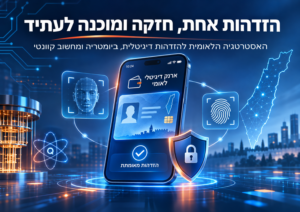
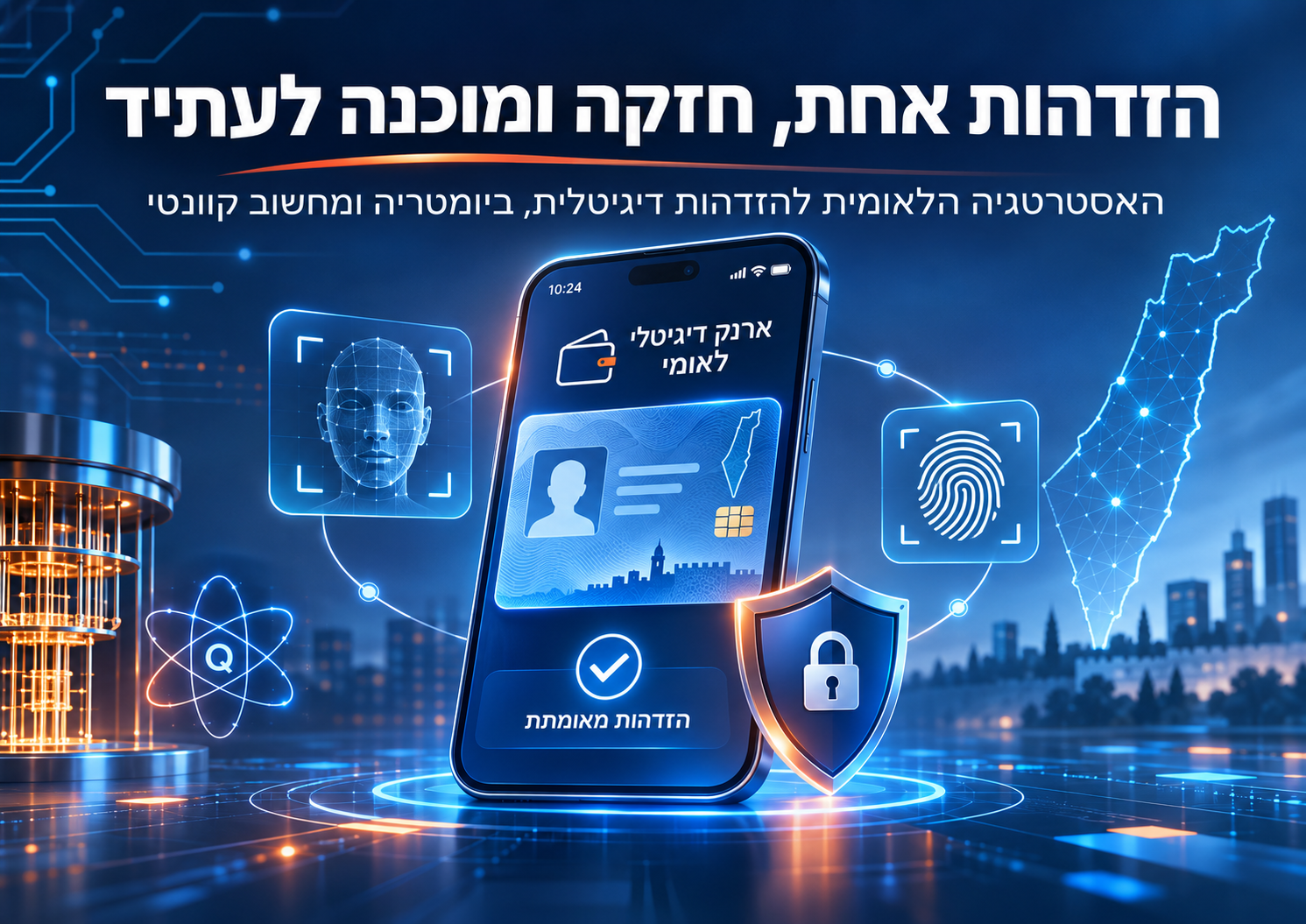
On November 8, 2026, at the start of National Cyber Defense Week, Israel’s National Cyber Directorate published a draft national digital identity strategy for public comment. It was prepared together with the National Digital Agency, the Population and Immigration Authority, the Budget Division at the Ministry of Finance, the Accountant General and the Bank of Israel. The draft’s main elements are: a single, trusted digital identity for every resident, to be used gradually by banks, insurers and healthcare providers; a national digital wallet for official credentials; and a link between the digital identity and the national biometric records, meaning biometric ID cards and passports. Alongside these, it sets an explicit goal of preparing for the era of quantum computing.
The draft is open for public comment until November 30, 2026, at [email protected].
First, credit where it is due
In our view, this is a significant and comprehensive document that presents a broad picture of the technological, business and regulatory challenges of building a national digital identity infrastructure. The steering committee, set up on the initiative of the head of the Digital Identity and Biometric Applications Unit at the National Cyber Directorate, examined the models of Belgium, Estonia, Australia, the United Kingdom, Singapore and the European Union, and consulted the financial sector, the healthcare sector, industry and the telecommunications sector. The result is more than a technology plan. It is a document that openly addresses the hard questions: allocation of responsibility, privacy, the economic model, and the balance between convenience and security. The unit head, Naama Ben Zvi, summed it up this way: “Digital identity is no longer a point technology component, but a national trust infrastructure.”
The problem the strategy aims to solve
According to the document, Israel starts from a position that many countries do not enjoy: a central population registry, biometric ID cards and passports, and a national authentication system launched in 2020. The National Cyber Directorate says about 5.5 million users are already registered in it. But these assets were never connected into a single system. Today, the national system does not verify against the biometric records during enrollment. Another system run by the Population and Immigration Authority, which serves about 408 entities, including 57 financial institutions, verifies registry details only, without binding the user to their identity.
The result is familiar to everyone: multiple accounts and passwords, and a separate enrollment process with each organization. The Directorate also states that photos of ID cards are sent and stored in many databases, sometimes without adequate protection. Each of these databases is a target for leaks and impersonation.
A changed threat: attackers don’t break in, they impersonate
The document describes a fundamental shift in the threat landscape: the focus of attacks is moving from breaking into infrastructure to impersonating legitimate users, using stolen, forged or synthetic identities. Generative AI enables deepfakes and presentation attacks. A presentation attack is the display of an image, video or mask in front of a camera in order to fool an identification mechanism. According to the document, this requires moving from protecting systems alone to managing identity and fraud risk across the entire identity lifecycle.
Why biometrics, and how to use them properly
A password is a secret, and a secret can be stolen, guessed or extracted through phishing. A photo of an ID can be copied. By contrast, biometric verification against the national records makes it possible to bind a digital identity to the actual person, with a high level of assurance. According to the document, the National Digital Agency and the Population and Immigration Authority are developing an advanced biometric verification application against the national records. It will be used for enrollment in the authentication system and for actions that require a high level of trust, and will later be integrated into the digital wallet as well.
It is important to be precise here, because this is where the line between proper and risky use lies. According to the US NIST digital identity guidelines, SP 800-63B-4 of July 2025, a biometric characteristic is not a secret: faces can be photographed, and biometric characteristics can often be obtained online or by other means without consent. NIST therefore specifies that in ongoing authentication, biometrics may be used only as part of multi-factor authentication together with a physical authenticator, such as a phone or smart card. It prefers on-device local comparison, requires presentation attack detection for facial recognition, and always requires a non-biometric alternative. Even so, biometric comparison remains probabilistic.
We believe this is exactly the right approach: biometrics can be a significant element in proving identity at enrollment, when the comparison is made against a trusted source such as the national records, and combined with appropriate controls. Afterward, it serves as a “key” that activates an authenticator held by the user. It is not a substitute for cryptography but a layer on top of it.
Biometrics also carry a unique sensitivity: a leaked password can be replaced, a fingerprint cannot. In our view, protecting biometric data, limiting the places where it is stored, and privacy by design are therefore not add-ons but prerequisites. The document addresses this explicitly: data minimization, selective disclosure, transparency toward the resident, and proactive alerts about use of the identity. According to the Directorate, in the planned model, user accounts with private-sector organizations will remain separate, and the government will have no access to activity within them; the role of the national system will be to verify identity only. The draft itself states that the state will not be exposed to the content of the service or to business activity, beyond the minimal information required to operate and secure the service, for oversight, and for handling fraud incidents.
And quantum? Why this is no longer science fiction
Much of what protects digital identity today relies on public-key cryptography: digital signatures, certificates and server authentication. According to NIST, a sufficiently powerful quantum computer could break the public-key cryptosystems that currently protect nearly all network activity. The strategy devotes a separate goal to this, preparing for the post-quantum era. According to the document, quantum computing is expected to challenge, in the coming years, the infrastructure used for digital signatures, identity verification and encryption, and the state will work toward early preparation and the building of a capability for a gradual transition to resilient infrastructure.
One of the main reasons to act now is known as “Harvest Now, Decrypt Later”: an attacker who collects encrypted data today will be able to decrypt it once quantum capability is available. In its October 2026 announcement, NIST notes that because of this threat, organizations may prioritize migration to the new key-establishment standard, FIPS 203, which defines the ML-KEM mechanism, especially for sensitive data or data that must remain protected over the long term. In our view, biometric databases are a prominent example: biometric data is not a secret for authentication purposes, but it is especially sensitive personal information and cannot be replaced. It is also important to distinguish: a quantum computer does not steal biometric data on its own. The risk is that biometric data an attacker collects today in encrypted form will be exposed in the future if the encryption protecting it is broken. And data that is stored without protection is already exposed today.
The world is already moving. In August 2024, NIST published the first three standards for post-quantum cryptography, FIPS 203, 204 and 205, and called for starting the transition immediately. In October 2026 it published the final document guiding the transition, NIST IR 8547. In Israel, according to a February 2025 report, the National Digital Agency instructed government bodies to map their infrastructure, identify exposed data, and require post-quantum encryption capabilities in new procurement.
| Status | What does this mean for you? |
|---|---|
| A bank, insurer, health fund or financial institution that identifies customers remotely | Within the sectors the strategy focuses on. According to the draft, in the future you may be able to use the system at the onboarding stage: on a voluntary basis, subject to criteria, approval, payment and regulatory adjustments |
| A business that stores ID photos of customers or employees | Relevant today: every such repository is an asset for an attacker. It is worth mapping and reducing it, subject to retention obligations under law |
| An organization that still relies only on a password and an SMS code | Relevant today: phishing-resistant authentication methods are available now, without waiting for the national system |
| An organization that holds sensitive data for the long term | Relevant today: it is worth starting with an encryption inventory and a post-quantum migration plan |
| Anyone expecting the national system to replace the know-your-customer process | No. According to the document, it will strengthen identification at enrollment and will not replace the full KYC process. In any case, responsibility for KYC and compliance obligations remains yours, under the law that applies to you |
| Anyone expecting a binding timeline | Not yet. This is a draft for public comment; a five-year implementation plan will be developed later |
What to do now
The following steps are our professional recommendation, and are not part of the strategy:
1. Map the identity documents you hold: where ID photos are stored, who accesses them, and for how long. Reduce whatever is not required by law. For what remains: defined access permissions, a retention period and deletion policy, encryption, and logging of every access to the documents.
2. Strengthen authentication today: phishing-resistant multi-factor authentication for employees and sensitive systems. According to NIST, a one-time code or approval over a separate channel, such as a push notification, is not considered phishing-resistant, whereas cryptographic authentication, such as FIDO2 or passkeys, can meet the requirement: the authentication is cryptographically bound to the genuine website, so a spoofed site cannot use it.
3. Build a cryptographic inventory: which systems use which algorithms, and which data must remain confidential for years to come. To prioritize, rank each system by the sensitivity of its data, how long that data must stay confidential, its importance to business continuity, and its dependence on vendors and third-party systems. This is the starting point that the US agencies CISA, NSA and NIST also recommend in a joint guide.
4. Ask your vendors: whether they have mapped the cryptographic components in their products, what their post-quantum migration plan is and when it will happen, whether the cryptography can be updated without replacing the system, and whether they depend on components outside their control.
5. Make your voice heard: if your organization identifies customers, the draft is open for comment until November 30, 2026. This is an opportunity to influence how the system will be opened to the private sector.
Risks and warnings
This is a draft: changes may follow the public comments, and timelines have not yet been set. Do not rely on the national system as an existing solution for the private sector.
Centralization is also a target: a single national identity infrastructure is an asset, but also an attractive target for attackers. The document itself defines the system as critical national infrastructure and stresses security by design, operational continuity and redundancy. As a relying party, do not assume that a verified identity means everything is fine: keep monitoring for anomalous activity on your side.
Delete documents with care: your organization may be subject to legal obligations to retain identity documents, for example under anti-money-laundering rules. Obtain legal review before deleting anything.
Biometrics are not a silver bullet: without presentation attack detection and a physical authenticator that holds the key, the risk of misidentification increases, and even with these measures the comparison remains probabilistic. And a future quantum computer could threaten the encryption that protects these layers, including biometric databases.
| T.O.M recommendation: in our view, the National Cyber Directorate and its partners have laid important groundwork here, and its two messages apply to every business today: identification is moving from “what you know” to “who you are” and “what you hold”, and the encryption protecting all of this needs to be prepared for the quantum era. In our experience, the two steps that deliver the most benefit in the least time are reducing the ID photos your organization stores and moving to phishing-resistant authentication. Quantum mapping is worth starting now, because it takes time. If you would like to go through this together, get in touch. |
Sources
• NIST, announcement of the first three post-quantum standards, FIPS 203, 204, 205, 13.8.2024
• NIST, IR 8547, Transition to Post-Quantum Cryptography Standards, October 2026
• NIST, announcement of guidelines for the transition to post-quantum cryptography, 27.10.2026
• Joint guide by CISA, NSA and NIST on preparing for the migration to post-quantum cryptography
• Ynetnews, National Digital Agency directive to government bodies on the quantum threat, 19.2.2025
As of November 2026. All sources were checked on 9.11.2026, and again on 10.11.2026 in the revision round. This article summarizes a draft that is open for public comment; the final wording of the strategy may change.
| DisclaimerThe information in this article is provided for explanatory and general informational purposes only, based on public sources and accurate as of the time of writing. It does not constitute professional advice, a recommendation to act, or a substitute for a specific review of your environment. Systems, versions, network equipment and organizational policies differ from place to place, so results may vary.
Any change to system settings, and in particular to servers and production environments, is made at the sole responsibility of the person carrying it out, after documenting the existing state, taking a backup, within a maintenance window, and with the approval of an authorized IT professional. T.O.M at your service Ltd. will not be liable for any damage, direct or indirect, data loss or downtime arising from the use of this information. If in doubt, consult us before proceeding. |
© T.O.M at your service Ltd | The Experts in Creating Peace of Mind | tom-comp.com
#TOMTechTip #WeeklyTechTip #TOM_ITServices #DigitalIdentity #PostQuantum #CyberSecurity
👈 To book a consultation directly in our calendar: click here
📲 Want a practical weekly tip straight to your phone?
Join our WhatsApp channel – one computing, cyber and cloud tip a week, no spam, and your number stays private:
👈 One-click join: link