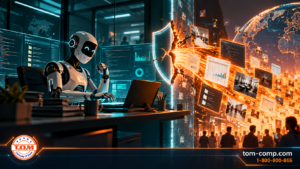

Risks are increasing, attacks are growing more sophisticated, and employees remain the weakest link.
The 2024 CERT-IL report paints a concerning global picture – and I’m adding what I see on the ground.
The Threat is Closer Than You Think
In a world where cyberattacks are escalating year after year, the 2024 CERT-IL report outlines a troubling reality:
Attackers are becoming more sophisticated, attacks more targeted, and the damage more severe.
For many organizations, the question is no longer “if we’ll be hit” – but rather “when, and how prepared will we be?”
Before you continue reading, it’s important to understand:
Today’s cyber threats are no longer reserved for giant corporations or government agencies.
They are much closer to home than most people think.
And the good news? There is a solution.
Our company has the knowledge, tools, and advanced solutions to protect your organization.
But to fight the threat – you must first understand it.
Know it. Understand what the threat landscape looks like and how to prepare properly.
The Alarming Trends of 2024
The report, published by Israel’s National Cyber Directorate (CERT-IL), details global and domestic cybercrime activity, alongside disturbing forecasts for 2025.
Key emerging trends include:
-
A significant increase in the use of ransomware
-
A rise in data theft-based attacks (rather than encryption)
-
The adoption of advanced tools such as artificial intelligence, smart contracts, and cloud technologies
In addition, we’re seeing more attackers operating in globally coordinated groups – sometimes funded or backed by nation-states.
The Numbers Tell the Story
According to the report, over 6,000 ransomware attacks were recorded globally in 2024 – a 15% increase from the previous year.
Israel is not immune, with more than 300 reported ransomware attacks and over 52,000 cases of Infostealer malware.
And it’s not just large enterprises:
Industries such as law firms, garages, dental clinics, and logistics companies have all suffered significant damage.
In fact, small businesses – often lacking adequate protection – are particularly vulnerable.
“It Won’t Happen to Me” – The Most Expensive Mistake
As someone who works closely with organizations in IT and cybersecurity, I repeatedly witness a dangerous phenomenon:
Many businesses ignore the threat, insisting, “It won’t happen to me.”
They treat cybersecurity as an expense – instead of understanding it as a form of insurance.
And when the event occurs – which statistics show is likely – the real cost is enormous:
Data loss, reputational damage, extortion, regulatory fines, and sometimes, total operational paralysis.
The Weakest Link: Human Error
Another critical – and often neglected – area is employee education and training.
More than 80% of cyberattacks succeed due to human error:
Clicking on a malicious file, giving away credentials to a fake window, or opening the wrong attachment.
Even the most advanced system cannot protect an unaware user.
Legitimate Tools, Malicious Intent
The report describes how attackers are leveraging legitimate tools such as RMM (Remote Monitoring and Management software) or MFT (Managed File Transfer interfaces) to infiltrate organizations – often leaving no trace.
There is also a noticeable shift away from traditional encryption-based extortion toward other methods:
Stealing sensitive data and threatening its release, using decentralized infrastructure, and launching advanced social engineering campaigns.
Beyond Technology: Responsibility and Culture
The takeaway is clear:
Cybersecurity is no longer just a technological field – it’s risk management, executive responsibility, and above all – organizational culture.
True, there is no magic solution or guarantee of complete protection.
But there’s a lot you can do to minimize risk:
-
Provide ongoing employee training
-
Secure your cloud configurations
-
Install updates in real time
-
Use multi-factor authentication
-
Upgrade from basic antivirus to advanced EDR systems
-
Plan disaster recovery scenarios in advance
Looking Ahead to 2025: Preparing for the Storm
Looking toward 2025 only reinforces this understanding:
Attacks will become more complex, artificial intelligence will serve the attackers too, and both direct and indirect costs will continue to rise.
Still, there is a silver lining – international enforcement cooperation is improving, public awareness is growing, and innovative solutions are emerging.
Shared Responsibility
In the end, it comes down to a simple but critical truth:
Cybersecurity is not just the “IT department’s problem” – it’s the responsibility of every manager, every team, and every employee.
The sooner we understand that – the stronger we’ll stand against the threats of tomorrow.
Want to see the full picture?
Leave a comment saying “I want to be protected” and we’ll send you the full report – no strings attached.