🟢 Understanding and planning – for every organization | 🟡 Configuration changes – for IT teams | 🔴 Penetration testing – qualified professionals only
As of November 2026 · Intended for: Executives · IT and Information Security Managers · Organizations that develop or use artificial intelligence
Not intended for: Readers looking for technical configuration instructions or a certificate. This article does not replace the text of the standard and does not constitute legal advice regarding the EU AI Act.
| Risk classification:
🟢 Green – Safe: Reading the standard, mapping the organization’s AI systems, preparing a threat model, and incorporating threats into risk management. These are planning activities that do not change any systems. 🟡 Yellow – Caution: Changing permissions, filtering settings, and logging configurations in AI systems – to be performed by the IT team under change-management procedures and after documenting the existing state. 🔴 Red – Qualified professionals only: Controlled security testing (Red Teaming). When performed against a live system, such testing may expose real data or trigger unintended actions. It should therefore be conducted only within an agreed scope, in a test environment, or during an approved maintenance window. This article does not provide execution instructions. |
In a nutshell
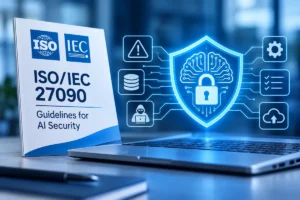
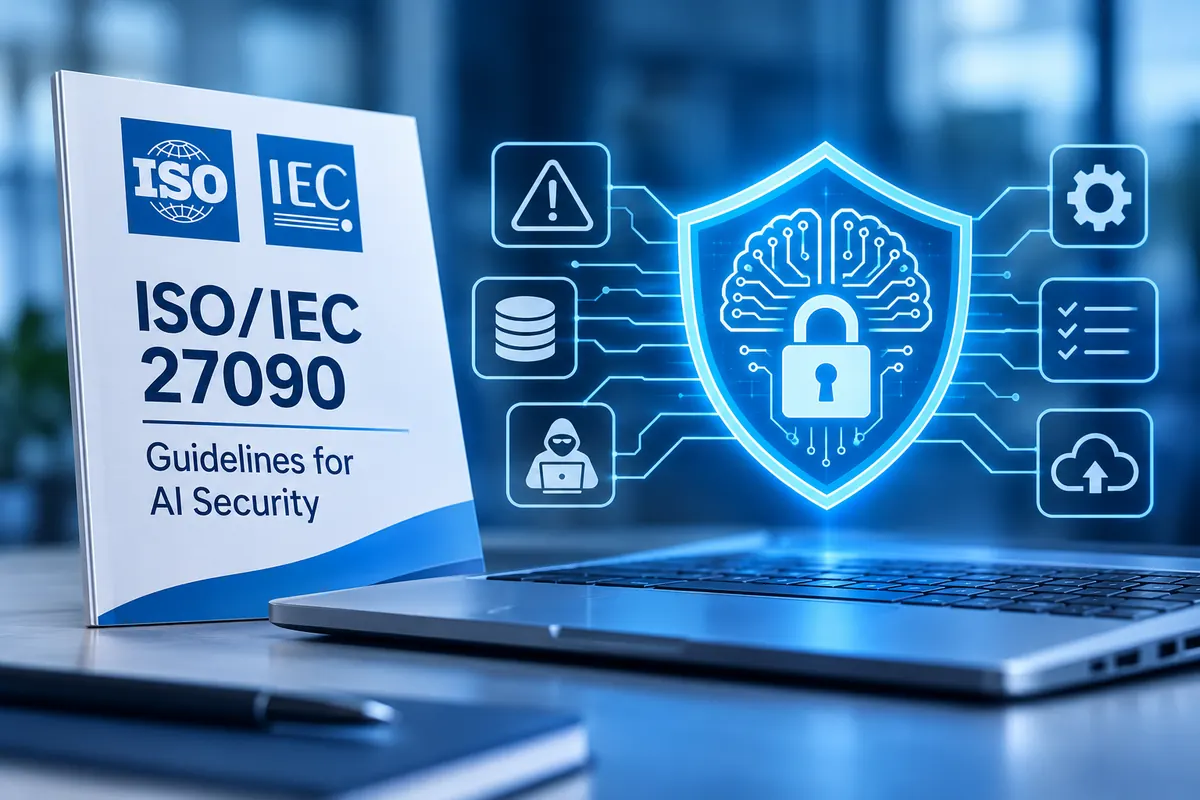
On October 14, 2026, the first edition of ISO/IEC 27090 was published: an international guidance standard issued by ISO and IEC that addresses security threats and vulnerabilities specific to artificial intelligence systems. The standard helps organizations understand how these threats may materialize, what their potential consequences may be, and which measures can help detect and reduce risk throughout an AI system’s life cycle. It complements existing information security practices; it does not replace them. For an organization already using an AI assistant, chatbot, or autonomous agent, it may serve as a practical roadmap.
An important note upfront: the full text of the standard is available for purchase. Facts about the standard itself, such as its publication date, scope, and applicability, are taken from the standard’s page on the ISO website and its record on the IEC website. The description of its structure and attack categories is based on two professional reviews. This is a secondary-source summary, not a substitute for consulting the standard itself.
What exactly was published?
This is the first edition, comprising 56 pages. It was developed by subcommittee ISO/IEC JTC 1/SC 27, the same committee responsible for ISO/IEC 27001, the well-known information security standard. According to the standard’s abstract, it is intended for organizations of all types and sizes: public- and private-sector companies, government bodies, and non-profit organizations that develop or use AI systems.
It is important to be precise: ISO/IEC 27090 is a guidance standard, not a requirements standard for a management system intended for formal certification, as is the case with ISO/IEC 42001. Commercial offers for an “ISO 27090 certificate” should therefore be examined carefully, with a clear understanding of what is actually being assessed. An organization uses the standard to identify risks and select controls within its existing information security or AI management framework.
What is new?
Among the major ISO standards that preceded it in this field are ISO/IEC 42001 (December 2023), which specifies requirements for an AI management system and is certifiable; ISO/IEC 23894 (February 2023), which provides guidance on risk management for AI systems; and ISO/IEC 42005 (May 2025), which addresses the impact assessment of AI systems on individuals and society.
ISO/IEC 27090 focuses on a practical question: how can an AI system be attacked, and how can it be defended? In our view, this is its main contribution and what makes it particularly relevant. Some attacks on AI systems do not involve breaking into anything. Instead, they exploit the data and inputs the system was designed to process: a document containing a hidden instruction, poisoned training data, or a series of queries that extracts information from the model that it was not supposed to disclose. Traditional security controls, such as firewalls and antivirus software, do not always detect these attacks because, from their perspective, everything may look like normal use. Put simply: an attacker does not always break down the door. Sometimes, the attacker persuades the system to open it.
Another point highlighted on the standard’s page on the ISO website is that conventional security remains essential. ISO/IEC 27090 complements ISO/IEC 27001 and ISO/IEC 27002; it does not replace them.
The methodology: from threat, through failure, to detection and prevention
Two professional reviews published after the standard’s release, by Kertos and Abilene Academy, describe a similar structure. According to these reviews, the standard is built around three main components:
The foundation – how to apply security to AI: an AI governance program, the Zero Trust principle (no component is trusted by default), software engineering practices, supply-chain security (models, libraries, and data obtained from external sources), threat modeling, and controlled security testing (Red Teaming).
The core – attack categories: According to both reviews, the standard identifies nine attack categories, which are presented in the table below. According to the Abilene Academy review, for each category the standard describes what it is, which failures it can cause, how it can be detected, and how it can be mitigated. The entire methodology can be summarized in one sentence: from a threat, through the failures it causes, to detection and prevention.
Security measures and how they interact: According to both reviews, the standard also describes the interactions between security measures. The Abilene Academy review further notes the possibility that these measures may conflict with one another, and that their effectiveness may erode over time. In our view, this is a mature recognition of real-world conditions. One example: aggressive input filtering may block an attack, but it may also impair usability.
According to both reviews, the standard also includes three informative annexes. According to the Kertos review, Annex A maps attack categories to system life-cycle stages and assets; Annex B explains AI variants of familiar attacks; and Annex C addresses Federated Learning.
The following table summarizes the attack categories as described in the professional reviews. It is intended to explain the terminology in business-friendly language; it is not an official translation or quotation of the standard’s clauses. For implementation purposes, the terminology and guidance should be verified against the full text.
| Attack category | In plain language |
|---|---|
| Data poisoning | Introducing malicious data into training datasets so that the model learns incorrect behavior or a backdoor. |
| Evasion | An input specifically crafted to cause the model to make a mistake. For example, in a classification system, a malicious file may be classified as legitimate. |
| Membership inference | Determining whether a particular record, such as a customer’s record, was included in the training data. |
| Model exfiltration | Stealing the model or extracting its knowledge and behavior: through unauthorized access to model components, or through queries that make it possible to build a model that imitates it. |
| Model inversion | Inferring characteristics or sensitive information about training data from the model’s outputs. |
| Direct model poisoning | Modifying or replacing model components or pre-trained components, as distinct from poisoning the training data. |
| Sensitive model output | The model discloses information in its responses that it was not supposed to reveal. |
| Prompt injection | A malicious instruction in an input, either directly or embedded in a document, email, or website that the system reads, causing it to act against its owner’s intentions. |
| Output contains injection attacks | An output containing malicious content or instructions, such as code or a command, that may cause the receiving system to perform an unsafe action. |
The principles and our practical interpretation
According to the standard’s page, its guidance applies throughout the entire life cycle of an AI system. The additional points below are our own practical interpretation for businesses:
Full life-cycle coverage: Security begins with data collection and model selection, and continues through training, testing, deployment, and monitoring. An attack can be introduced at any of these stages.
Zero Trust for AI as well: A model is a component that can be deceived. Therefore, the permissions granted to autonomous agents built on it must be enforced in the target system and at the API layer, not merely through instructions given to the model. Read and write permissions should be separated, and human approval should be required for actions with significant impact.
Supply chain: In our experience, most businesses do not train their own models; they use models and services provided by vendors. It is therefore advisable to treat the model provider as a critical supplier and assess it as carefully as any supplier that handles sensitive information.
Test like an attacker: Conduct threat modeling before deployment and ongoing security testing after changes. A full controlled security assessment should be performed at a scope proportionate to the risk. It is classified as 🔴 and should be carried out by qualified professionals only.
Monitor and document without compromising privacy: Inputs and outputs may contain personal information, business secrets, or access credentials. Therefore, record only what is necessary to detect misuse and investigate incidents, protect logs and restrict access to them, and define a retention period.
The regulatory context
Article 15 of the European Union’s Artificial Intelligence Act (AI Act) requires high-risk AI systems to achieve an appropriate level of accuracy, robustness, and cybersecurity. Among other things, the article refers to data poisoning, model poisoning, inputs designed to deceive the model, attacks on confidentiality, and model flaws. The terms used in the law are not identical to those used in the standard. In our assessment, some of them overlap with the attack categories addressed by ISO/IEC 27090.
The date of application depends on the system’s classification. Under Article 113 of the Act, as amended, the requirements for high-risk systems will apply from December 2, 2027, to systems listed in Annex III, and from August 2, 2028, to AI systems that are safety components of regulated products, or are themselves such products, under Annex I, where third-party conformity assessment is required. These dates were updated by an amendment to the Act that entered into force on July 27, 2026: Regulation (EU) 2026/1744.
Selling an AI product or service in Europe does not, by itself, make it a high-risk system. Classification depends on the system’s intended purpose and the categories specified in the Act. For systems listed in Annex III, the Act also provides a limited exception, subject to specified conditions, for systems that do not pose a significant risk. This exception does not apply to systems that perform profiling of individuals. ISO/IEC 27090 may help organizations map threats and design controls, but it does not, by itself, establish compliance with the Act. Israeli businesses selling into Europe should obtain a case-specific legal assessment.
The following table reflects our assessment of which organizations may find the standard relevant:
| Situation | Is it relevant? |
|---|---|
| An organization that develops an AI-based product or service | Yes – it is within the standard’s intended audience. |
| A business that uses an AI assistant, a customer-facing chatbot, or an agent connected to internal systems | Yes – particularly with regard to prompt injection, sensitive model output, and the supply chain. |
| A business whose employees use a public AI tool without connecting it to internal systems | Yes, to a limited extent. The risk is lower, but an acceptable-use policy and protection of information entered into the tool are still required. |
| An organization certified to ISO/IEC 27001 or ISO/IEC 42001 | Yes – the standard may help enrich risk analysis and control selection. |
| An organization looking for a new certificate to present to customers | No – the standard is not a requirements standard intended for certification. |
| An organization looking for a replacement for conventional information security | No – the standard complements conventional security; it does not replace it. |
| An organization looking for proof of compliance with the EU AI Act | No – the standard can support planning, but does not, by itself, establish compliance. |
How to get started without being overwhelmed
The following steps are our professional recommendations in light of the standard; they are not quotations from it:
1. Map: Prepare an inventory of all AI systems in the organization. This includes not only assistants and chatbots, but also AI capabilities embedded in existing systems such as CRM, ERP, and support platforms; add-ons; APIs; local models; development tools; autonomous agents; and tools employees may have started using without approval. For each system, record its business and technical owners, provider and model, purpose of use, types of information entered, connections and permissions, and actions it can perform autonomously.
2. Prioritize: Prepare a concise threat model, starting with systems that score highly across three dimensions: information sensitivity, the level of permissions and actions, and the business impact of an error or misuse.
3. Integrate: If the organization follows ISO/IEC 27001, add the nine attack categories to its risk analysis and assess AI providers within the existing supplier-management process. There is no need to create a parallel framework.
4. Restrict permissions (🟡): Apply least-privilege permissions to agents, enforced in the target system rather than only through instructions to the model. Separate read and write permissions, and require human approval for actions with significant impact. These are configuration changes and should therefore be handled by the IT team under change-management procedures.
5. Log carefully (🟡): Where supported by the system and in accordance with the organization’s privacy and data-retention policies, document the identity of the user or agent, the tools and interfaces invoked, the actions performed, and the necessary inputs and outputs. Protect logs, restrict access to them, and define a retention period. Do not retain sensitive information beyond what is necessary.
6. Test: Conduct ongoing security testing after every significant change to the model, data, or integrations. Before going live, carry out a controlled security assessment, classified as 🔴, with a scope proportionate to the risk and agreed in advance. It must be performed by qualified professionals only, in a test environment or during an approved window, using dedicated test data and a response plan for unexpected effects.
Risks and cautions
A certificate that is not certification under the standard: ISO/IEC 27090 is a guidance standard, not a requirements standard. Before relying on a commercial “ISO 27090 certificate,” it is advisable to clarify exactly what was assessed and by whom.
A review is not a substitute for the full text: An organization planning to implement the standard seriously should purchase the full text and work directly from it.
Security testing is a sensitive activity: A controlled assessment against a live system may expose real data or trigger unintended actions. It should be conducted only within an agreed scope, in a test environment or during an approved maintenance window, and by qualified professionals only.
The field is evolving rapidly: In our assessment, attacks on AI, particularly those targeting autonomous agents, are evolving faster than standards can be updated. The standard is a good foundation, but it is not the endpoint.
| T.O.M’s recommendation: In our view, ISO/IEC 27090 gives AI systems a common language for describing threats and a clear methodology for moving from threats to controls. An organization that already follows ISO/IEC 27001 generally does not need to build a framework from scratch. It can begin with three steps: add AI systems to its asset inventory, incorporate the nine attack categories into its risk analysis, and include AI providers in supplier assessments. In our experience, the most important first step is knowing which AI systems are actually operating within the organization and what they are connected to. If you would like us to carry out this mapping together, contact us. |
Sources
• ISO, ISO/IEC 27090, Addressing security threats and compromises to AI systems – standard page
• IEC Webstore, ISO/IEC 27090:2026 – publication date, scope, and abstract
• Kertos, ISO 27090 Explained: AI Security in Your ISMS, October 15, 2026 – review
• Abilene Academy, ISO/IEC 27090:2026 for AI Security, October 20, 2026 – review
• IEC Webstore, ISO/IEC 27001:2022 – standard record and responsible committee
• Institute for Standardization of Serbia, ISO/IEC 42001:2023 – AI management system
• ISO, ISO/IEC 23894:2023 – guidance on AI risk management
• ISO, ISO/IEC 42005:2025 – AI system impact assessment
• European Commission, AI Act, Article 6 – classification of high-risk AI systems
• European Commission, AI Act, Article 15 – Accuracy, robustness and cybersecurity
• European Commission, AI Act, Article 113 as amended – dates of application
• EUR-Lex, Regulation (EU) 2026/1744 – amendment to the Act, July 8, 2026
As of November 2026. All sources were checked on November 4, 2026. At the time of our review, the standard’s page on the ISO website still indicated that it was “under publication,” while the IEC record showed a publication date of October 14, 2026. The description of the structure and attack categories is based on professional reviews because the full text is available for purchase. These details should be verified against the published standard.
| Disclaimer
This article is provided for general informational and educational purposes only, based on publicly available sources and as of the date of writing. It does not constitute professional advice, a recommendation to take action, or a substitute for an assessment of your specific environment. Systems, versions, network equipment, and organizational policies vary; therefore, results may differ. Any change to system settings, particularly on servers and in production environments, is the sole responsibility of the person carrying it out. Such changes should be made only after documenting the existing state, taking a backup, scheduling a maintenance window, and obtaining approval from a qualified IT professional. T.O.M at your service Ltd shall not be liable for any direct or indirect damage, data loss, or service disruption resulting from the implementation of the information in this article. If in doubt, consult us before taking action. |
👈 To schedule a consultation directly in our calendar: Click here
📲 Would you like to receive a professional weekly tip directly on your phone?
Join our WhatsApp channel for one weekly tip on IT, cybersecurity, and cloud – no spam, and your phone number is not visible to anyone:
👈 Join with one click: Join the channel
© T.O.M at your service Ltd | The Experts in Creating Peace of Mind | tom-comp.com